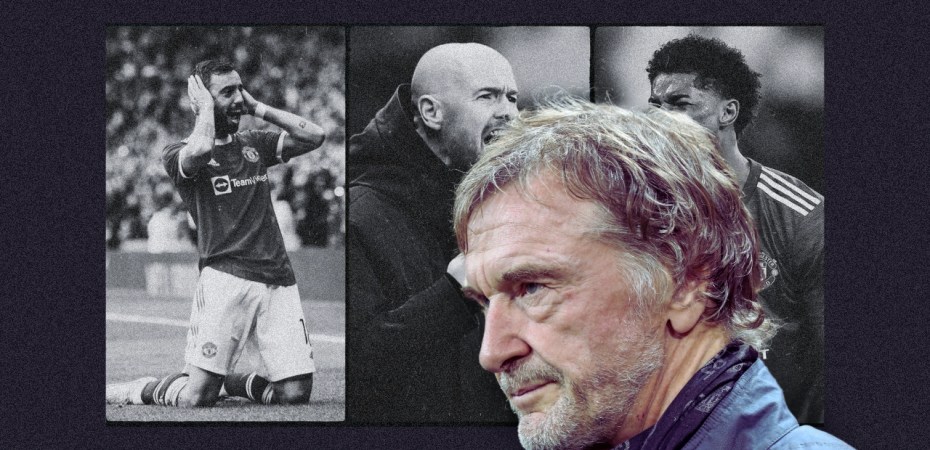

Life has three constants: death, taxes, and Manchester United defying expectations —good, and sometimes terribly bad. One of those constants manifested on August 22nd, 2022, when the Red Devils secured their first victory of the season under Erik ten Hag, rebounding from earlier —and honestly embarrassing, setbacks against Brighton and Brentford.t
Despite the expectations for a triumphant start to the league, following a dismal end to the previous season, the season’s start was a nightmare.
The turning point came in a game against Liverpool, where goals from Jason Sancho and Marcus Rashford inspired a four-game winning streak.
But not until Liverpool fans took the opportunity to mock United fans inside Old Trafford, chanting “Glazers in” and brandishing flyers featuring the Glazers’ faces.
It wouldn’t be the first time United have been mocked by rivals using the Glazers´ ownership as ammunition, and it wouldn’t be the last.
But it would be the first time the Florida-based owners finally cede some control to another party, at least for now.
As of January 31st, 2024, Man United currently sits in 9th place in the league table with 32 points, scoring two goals less than newly promoted side Luton Town. The acquisition could not have come at a better time.
INEOS stated, “The ambition is to have successful and sustainable football clubs with success in their respective leagues with the ability to reach European competition.”
This alludes to the fact that they would — more likely than not- focus on fulfilling the club’s potential instead of squeezing as much profit from it as possible.
This is better explained when they said, “At the same time, it is expected that while the clubs are run federally like any other INEOS business, they will work together to optimize opportunities. This can be expected to encompass scouting, player assessment, and acquisitions, and medical and fitness.”
In business, you won’t find a single player—a savvy entrepreneur or a big-shot company—diving into ventures that put their hard-earned capital on the line without expecting a worthwhile return.
It’s a universal truth in the game: you risk to gain. Those gains could come in the form of a healthy profit, a bolstered reputation, or maybe some other lucrative outcome.
INEOS and Sir Jim Ratcliffe are no strangers to this fundamental principle. Their deep dives into the business world have always been carefully calculated moves, each step taken with an eye on the potential returns.
This is why the media coverage around Sheikh Jassim was interesting, to say the least. They might have you believe he wanted to acquire the club solely out of pure fandom, painting a picture of a passionate supporter opening up his wallet for love of the game.
But we often tend to fall into the trap of oversimplifications like that.
INEOS, a pharmaceutical and chemical industry titan, has a proven knack for revitalizing struggling ventures into remarkable successes.
Their acquisition of OGC Nice around five years ago – a French club that found itself in the shadows at 7th place hasn’t won them any titles, but why should it?
While there have been murmurs of discontent regarding certain aspects of the company’s leadership at Nice, the bottom line for fans is clear: results matter.
So, looking at the trajectory of Nice post-INEOS takeover reveals a compelling narrative. In the 2017 season, the club landed an unimpressive 8th place. Fast forward to the present, under the guidance of Favioli, Nice has undergone a significant transformation.
The team is now firmly entrenched as a genuine top-four contender, proving that the journey to success is gradual.
With INEOS setting its sights on Manchester United after securing a substantial 25% stake, questions arise about its potential impact on the English football giant.
The company has made it clear they will even gain complete sporting control and oversee some financial aspects of the club. This was proven true when their first appointment was to snatch Manchester City’s former COO, Omar Berrada.
This massive shift in ownership dynamics begs a critical question: what could INEOS do at Man United?
At the most successful club in England, implementing structural changes doesn’t always yield immediate, flawless results.
A recent restructuring saw Ed Woodward giving up some control, which paved the way for Richard Arnold’s appointment. That, in turn, saw the historic hiring of a director of football for the first time in the club’s history, John Murtough. The changes initially showed some promise, but then we saw a return to signing “big names.”
The club had rocked back and forth like a seesaw, briefly tilting towards fresh ideas with those changes. But before we could even enjoy the sunshine, We were yanked back by the gravity of “Big Names,” crashing and landing right back in the sandbox of familiar faces and tired plays. It felt like digging down with a plastic shovel and unearthing last year’s crusty birthday cake, with the “Happy Birthday” song still faintly buzzing in our ears. Not exactly progress, was it?
And just like that, it was back to the comfortable, predictable rhythm of the past failures since Sir Alex Ferguson retired.
Despite the optimism under Ole Gunnar Solskjaer’s tenure about the club finally having a set-in-stone philosophy, there’s clearly still an ongoing struggle to define a consistent philosophy on or off the pitch —something fans hope would finally change under INEOS.
With Richard Arnold stepping down as CEO and Berrada taking his place, the club faces another structural shift less than three years after the last one.
While Murtough hasn’t officially handed in his resignation yet, no one expects him to stick around, and INEOS aren’t exactly known for keeping the old guard.
As we’ve seen, they’re a company that likes to do things their way, and there are whispers that Murtough doesn’t fit that framework.
One of the main jobs of a DoF is to embody the club’s philosophy, so when it’s time to appoint a new manager, the transition should be as smooth as possible.
Brighton has mastered this art.
INEOS has had two Sporting Directors at Nice, who have overseen five permanent managers under their current structure. It took time to overhaul this system and bring in people who better aligned with INEOS’s philosophy and vision for running the club. But they eventually got around to doing it.
Jean-Pierre Rivère has been president since 2011, and Florent Ghisolfi joined as Sporting Director in 2022.
This approach could be replicated at Manchester United, with transfer decisions being taken by multiple entities rather than just one. It would ensure that decisions align with the manager’s tactical approach and the club’s overall philosophy.
The most common criticism of INEOS’ ownership of Nice seems to hinge on the club’s failure to secure a Ligue 1 title. This league has become the financial playground of PSG, the oil-rich, Qatari-owned record-breaking spenders.
To expect Nice to conquer this Goliath is like demanding Brighton Hove Albion to win a League that Manchester City almost completely dominates because they have a reasonably decent scouting and recruitment structure. Makes very little sense.
Things were different when Sir Alex Ferguson molded the club into his own image and became a dominant force that captured 42% of the Premier League titles in over 21 years. His approach is no longer viable in today’s football landscape.
Success now comes from a club-wide philosophy rather than just the manager’s personal vision. And INEOS has the potential to steer United towards this modern structure.
Of course, if the structure behind the philosophy is both incompetent and disorganized, it’s a gamble that won’t pay off. And Instant success is far from guaranteed.
But it’s better than the alternative because Man United and its fans have been living that alternative since 2013.
 Platonotes