It’s May 2023. Old Trafford thunders.
The deafening roar could’ve knocked a bird from the sky. Marcus Rashford had just unleashed a screamer from 30 yards.
The ball swerved, dipped, and found the top corner, leaving Ederson a helpless statue as the Brazilian international watched the ball fly past from the corner of his eye. Two points; that’s all it took for Manchester United to leapfrog Pep Guardiola’s relentless side and reach the pinnacle of the English football pyramid the club hadn’t seen since 2013.
In a heartbeat, Rashford sprinted towards the Stretford End, the stewards a mere inconvenience for the fans twisting and thrusting to get over the line and unleash a tirade of embrace on the academy graduate.
But it was nothing compared to the wave of adoration from his teammates about to crash over him.
His finger pressed against his temple, the now-iconic “thinker” celebration amplifying the delirium. His teammates smother him, a joyful red mass – Bruno Fernandes’ shouts barely audible over the massive cheers from the crowd.
In the dugout, the eruption was not that different. It was raw, almost uncontrolled. Ole Gunnar Solskjaer, unable to contain his boyish excitement, slams into Keiran McKenna, Michael Carrick, and Tom Phelan. Arms flail, men are lifted off their feet, shouts turn to tearful laughter. Solskjaer’s eyes glint – his glory days as a player when he last won a title flicker to life.
The game wasn’t even over, but they knew. They’ve done it. They’ve won the League.
It’s the perfect script, isn’t it? An alternate universe where certain transfers happened, and others never did. Where a Portuguese icon didn’t tip the scales in City’s favour. Maybe in that dream reality, it was destiny for that goal, for that title, to belong to United.
But in this reality? Where Cristiano Ronaldo joined the club, where Solskjaer left, where Ralf Rangnick came in… Well, the shade is still a little blue and a bald Spanish international is still making history. But even here, beneath a City-dominated oil-filled sky, the echo of Old Trafford’s thunder carries a strange kind of hope. It always does.
In the late summer of 2022, Manchester United made a seismic decision—they brought back Cristiano Ronaldo, the Portuguese prodigy turned global icon, from Juventus. It wasn’t a deal forged in boardrooms and months of media anticipation in the typical United Way. The deal was fueled by whispered phone calls between aging Red Devil legends and their relentless former teammate.
“I rang him (Ronaldo) straight away: ‘What’s going on? Tell me you’re lying.’ Every type of no, no, no in the conversation” Ferdinand had said about rumours of the Portuguese international eventually moving to City.
After it was clear Ronaldo would be coming to the red side of Manchester, the former United centre-back said,
“It’s a beautiful day man… Sir Alex Ferguson would have been the exact the same, he would have hated to see Cristiano in a Man City shirt, just like any other person that’s been connected for a long period of time with this football club.”
And for many fans, maybe a majority, that was true. It was a dream resurrected, a moment of pure fantasy. But for others, it was a massive misstep they saw as a betrayal of the hard-earned rebuild the club had pursued for the past three years under the Norwegian manager.
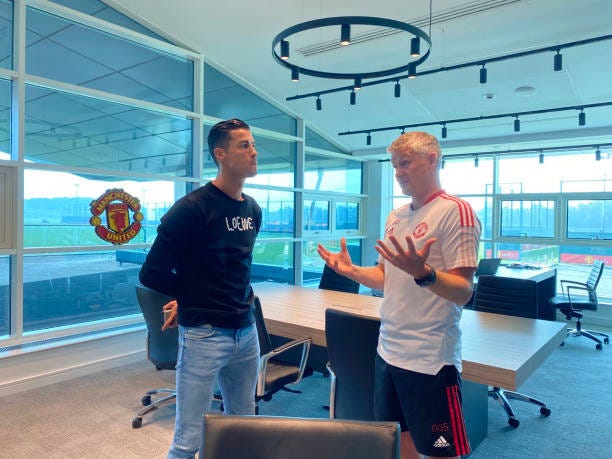
Solskjaer later told the Athletic two years later,
“It was a decision that was very difficult to turn down, and I felt we had to take it, but it turned out wrong.”
But it wasn’t difficult to sway a desperate fan base into believing that signing one of history’s best was unequivocally the right decision. Despite his advancing years, Ronaldo remained lethal in Serie A, scoring 36 goals in 44 appearances, so even from a somewhat logical point of view, United needed that kind of output. But the Premier League is a different beast, so there were no guarantees.
The allure of nostalgia is always too powerful to ignore – the prodigal son returning to right the wrongs at the club that forged him is up there with the most severe nostalgia-bait-obsessed Hollywood movies, maybe even more competent.
But it wasn’t just about goals; Ronaldo’s return promised experience, a champion’s mentality the club’s younger stars desperately needed.
There were doubts, and everyone knew it was a risk despite what the seemingly low transfer fee indicated. The move, as intoxicating as it was, presented the threat of undoing everything the club had constructed.
Ronaldo’s brilliance was undeniable, but the weight of his presence, of his ego, could crush the delicate chemistry the team was developing. It was nothing more than a signing built on romanticism, not cold tactical logic. And as the season unfolded, those fears wouldn’t just prove accurate— they’d prove devastating.
Expectations were mixed when the veteran star arrived. Some thought he would basically be a potent but very expensive super-sub. Instead, he became an instant, non-negotiable starter.
Solskjaer dared to put him on bench in favour of Cavani during a PL game against Everton that ended in a draw – a calculated gamble. Still, it backfired spectacularly and ignited a media firestorm that practically blamed Solskjaer for the draw.
Ronaldo came in as the team’s starting center-forward, but his style clashed with the free-flowing football Solskjaer had cultivated. The Portuguese legend didn’t have the relentless pressing energy and positional fluidity that had become the team’s signature.
But it wasn’t simply a failure of the individual, but a systemic breakdown. Yes, Ronaldo kept scoring, but at the cost of the team struggling. Attacks funnelled through him, stifling the creativity and dynamism of his teammates. It eventually became a problem Solskjaer couldn’t solve.
The Real Madrid legend’s homecoming may have ignited nostalgia, but it was also a turn away from the direction United had been plotting for years.
At 36, Ronaldo represented a bygone era in the club’s history—a penchant (maybe an obsession) for superstar signings over tailored team strategy fueled more by commercial ambition than on-field dominance. And if we look at the profit margins that came from his signing, Ronaldo was a massive success, at least in how the Glazers defined success, selling £187 million worth of shirts within the first ten days of his return to become the fastest-selling shirt in PL history.
It’s probably why it was important for the club to remove Cavani’s number 7 and maximize Ronaldo’s shirt sales even after the PL had already closed the window for awarding shirt numbers.
But before Ronaldo’s return, United weren’t in a downward spiral. The team was already moving up the League and doing reasonably well in Cup competitions. Consecutive 3rd and 2nd place finishes, consistent semi-final appearances, a Europa League final, and a rising goal count were all signs of a team still in the process of forging its identity patiently. They needed pragmatic reinforcements, yes—a world-class defensive midfielder, not a star striker, should’ve been their absolute priority.
But when whispers of Ronaldo’s availability reached Old Trafford, United had no choice but to give in to their historical impulse, still unable to resist the allure of a marquee legend. It was music to the ears of the Glazers.
Aside from the absolute demolition job against Leeds United in the opening game of the 2021/22 season, the scrappy first three matches of that season weren’t always dazzling, but they were promising, and the poorer performances were salvageable.
Then, Ronaldo arrived; his two goals against Newcastle United explosively reignited a childlike euphoria in the stands. ‘United were back!’ –– except this resurgence, unfortunately, masked the beginnings of a systemic breakdown in the tactical and philosophical structure the club was already struggling to nail down.
Ronaldo’s signing inflated expectations. Which was a positive for some, but United as a team were not ready to have their expectations inflated. The sudden pressure to immediately contend for titles was overwhelming. Despite a second-place finish the previous season, winning the League wasn’t the realistic goal, even with Raphael Varane and Jadon Sancho’s signings.
But from the first time, Ronaldo stepped onto the pitch, the media frenzy painted the team as champions-in-waiting even though there weren’t any whispers of this before the season started.
Some models raised United’s chances of winning trophies.
“The odds of United lifting at least one of these two major trophies (UCL and PL) has increased from 12 percent to 19 percent, or a roughly 1-in-8 chance to a roughly 1-in-5 chance” said Omar Chaudhuri, chief intelligence officer at the Twenty First Group.
“Our models estimate that Ronaldo’s arrival at Manchester United increases their chances of winning the league by five percentage points, from 7 percent to 12 percent,” he noted.
But United couldn’t be considered title challengers for many reasons. For years, the club had to rely on the makeshift defensive midfield pairing of Fred and Scott McTominay —which was highly effective but also had some glaring weaknesses. The duo brought energy and resilience, but neither was a natural defensive midfielder. Ole Gunnar Solskjær’s tactical hand was usually forced to sacrifice attacking fluency for midfield security, and the numbers usually vindicated his decision.
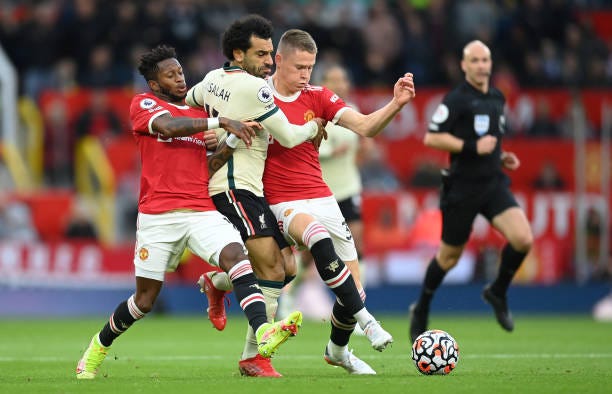
When “McFred” started games, United averaged 1.82 points per game; without them, that number dropped to 1.28.
The 2021/22 season, where the pivot started less frequently, saw United finish in their lowest Premier League points tally ever. Even Solskjær’s most humiliating defeats often came when both players were absent or didn’t play together.
But for United to move forward, they needed an upgrade on the duo. But they signed Ronaldo, whose arrival was a short-term solution to a long-term problem. But it was also the solution to a problem the club never really had, and even if they did, it wasn’t a priority. Rashford, Fernandes, and Edinson Cavani scored more than ten goals for a combined 39 the previous season.
Scoring goals was never a problem.
Ronaldo’s goal-scoring prowess was undeniable, though, scoring 24 goals across all competitions that season. And as Rio Ferdinand famously noted, “Where would the goals come from” if not from Ronaldo?
But his arrival masked United’s deeper issues and created an unhealthy reliance on “individual brilliance,” which stalled the development of a cohesive team identity. His presence also brought with it an undercurrent of dressing room unrest, possibly the icing on the cake because he had the same issues under Ralf Rangnick and Erik ten Hag.
Could not signing Ronaldo have been a catalyst for addressing United’s structural flaws? Without the crutch of his goals, the club might’ve been forced to invest heavily in a world-class defensive midfielder, a Declan Rice, or maybe a Casemiro, which would’ve solidified the team’s spine.
It also could’ve renewed emphasis on youth development, which always yielded long-term results for the club, acting as a prelude to fostering a culture of cohesion and collective responsibility rather than an irresponsible overdependence on individual players.
It’s impossible to say definitively, but the decision to bring in one of the greatest players of all time appeared to have stalled the necessary long-term rebuild at Manchester United.
I keep asking myself, “Could the club have been better in the long run without him? Could their deep-seated problems in tactics, structure, and philosophy have been addressed sooner rather than papered over?”
 Platonotes