
One of the biggest problems with football discourse these days is judging players without considering the tactical framework of their team —especially since we all agree that no two teams play precisely the same way. So, a winger on a team that loves to cross the ball will whip in more crosses than a winger on another team that focuses on scoring goals.
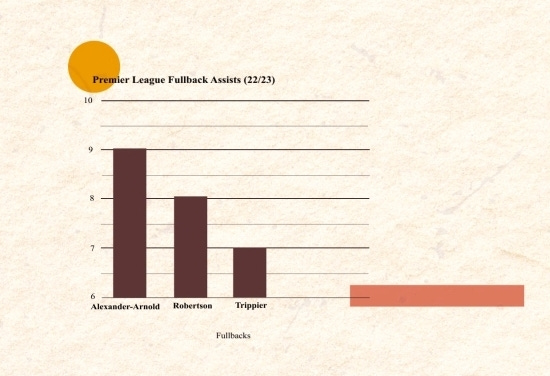
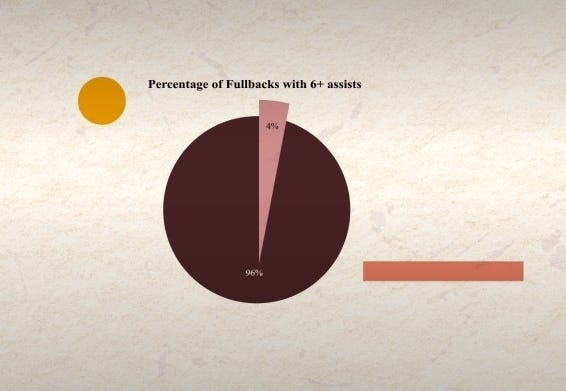
No fullbacks hit double digits in assists in the 22/23 Premier League season. In fact, Trent Alexander-Arnold was the only one who came close with 9, and just 3 others managed more than 5. So, out of 71 fullbacks with 500+ mins played, only 4% reached 6+ assists.
Tell me, are 96% of fullbacks in the league just bad at being fullbacks?
A year ago, Jurgen Klopp once again had Trent Alexander-Arnold’s back, a familiar stance for him, but it was a bit different this time.
The German international said,
“Yes, there are other situations where he was not aware or there was a challenge he should have won. Every player has these challenges. But with him? Every time it is picked up and analysed, all the experts say this is a weakness. Honesty, I just don’t get it. A world-class talent gets judged by the one thing he is not as world-class at as the other things? If he was not a good defender, he would not play.”
The Liverpool fullback is probably one of the most creative on the pitch, but his defensive game is also one of the worst. It’s fair to say it’s not exactly their strong suit.
And I’m not alone in calling out the need for defenders who can… defend.
The debates are endless, but football is a game of trade-offs, so there’s no easy answer.
In the past, the fullbacks of old were the deep defenders in 235 formations circa the 1920s, only shifting to the sides when the back four began to gain some popularity.
But the 235 setup defined fullbacks as defensive stalwarts, with minor exceptions like the 1958 World Cup when Nílton and Djalma Santos contributed more offensively in Brazil’s national team.
However, despite occasional flair, defending was their primary responsibility in the 20th century.
Their job was to stop the opposition with tackling and good positioning.
But football is a game of evolution, and the sport is nothing but an alchemy of changes, with fullbacks now being relied on to not just defend but also become creative forces in the attacking phase. And in the last two years, we’ve seen a steady influx of fullbacks moving into the midfield or just staying back to act as the third center-back.
So, what makes a great fullback?
Whether a fullback can turn into a goal-scoring machine or a defensive brick wall depends entirely on how the team wants to play.
Bayer Leverkusen’s Alex Grimaldo and Jeremie Frimpong have a combined 27 goals and assists in 35 appearances at the time of writing. This is surprising, considering they aren’t even the world’s best fullbacks, nor are they playing in the best attacking team in Europe.
Xabi Alonso’s team uses a back three formation, which reduces defensive responsibilities for the wingbacks, who become the team’s primary creative outlets.
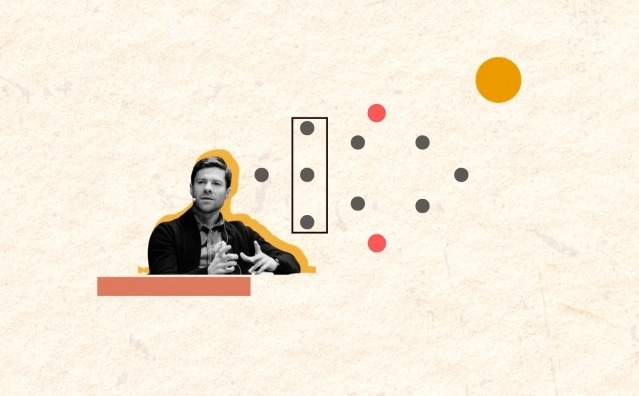
This means the wingbacks care less about defending and more about creating.
This approach is similar to how Jurgen Klopp set up his team in the 2019/20 seasons, where both Alexander Arnold and Andy Robertson combined for 25 assists, while most of the defensive burden rested on the midfielders, who did the dirty work of breaking up play.
Man United attempted a similar strategy during Ole Gunnar Solskjær’s first full season in charge, where the Norwegian shifted the creative burden to Aaron Wan-Bissaka and Luke Shaw before signing Bruno Fernandes a few months later.
So, how do we judge good fullbacks? What makes them good? Again, this depends on how the team plays and if that fullback is doing his duties well.
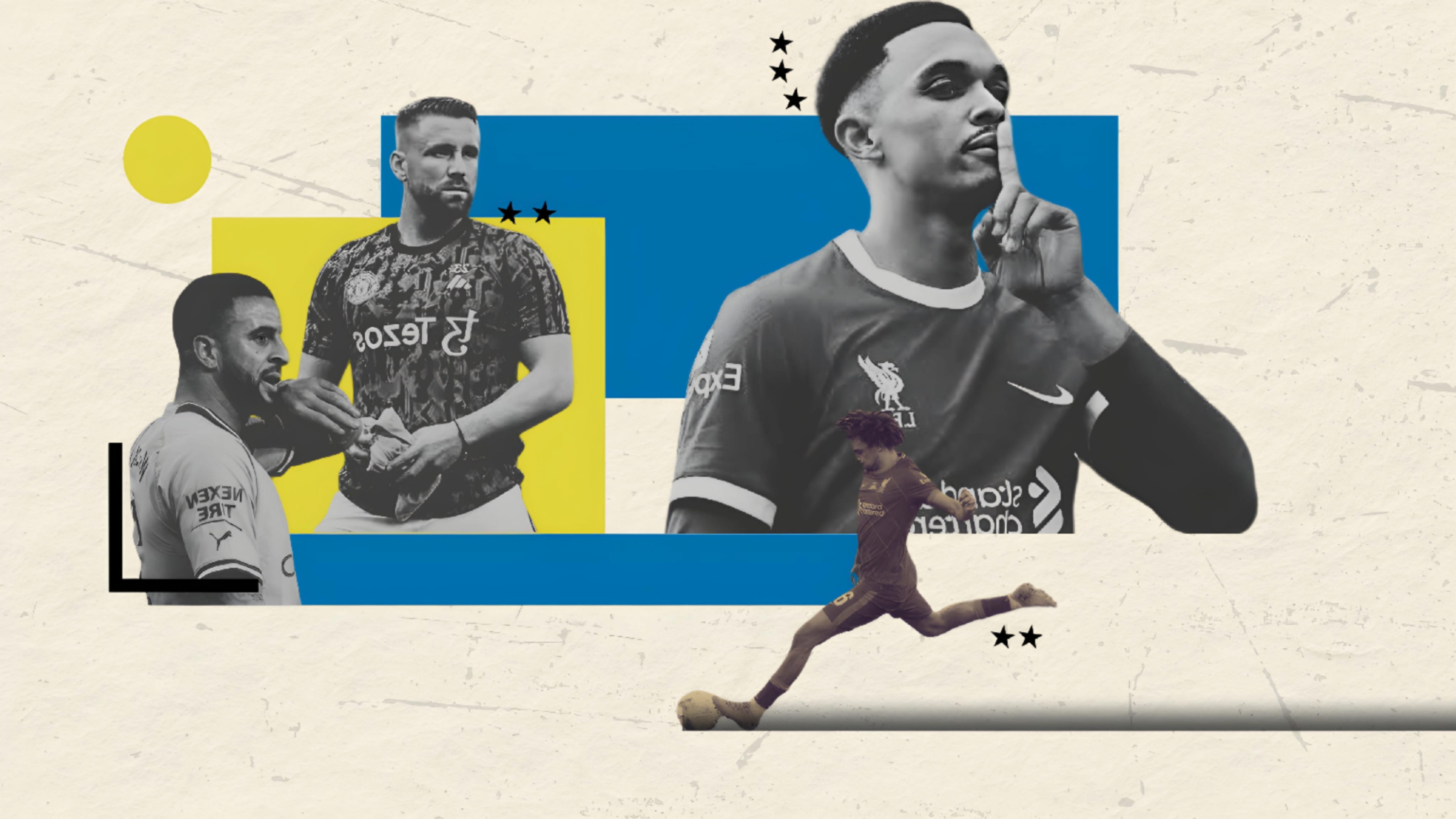
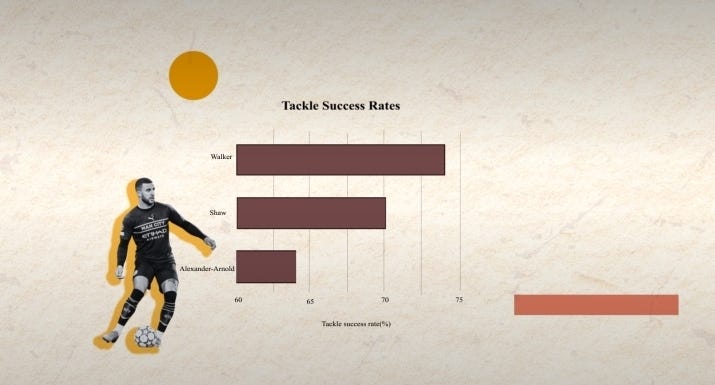
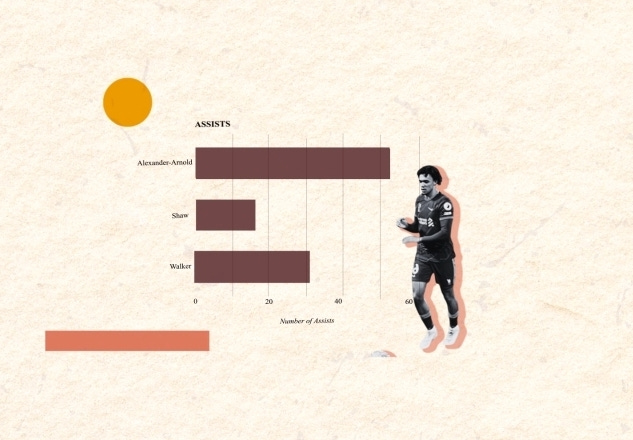
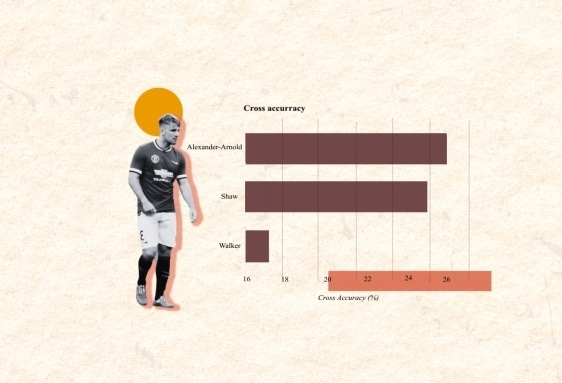
Look at Luke Shaw, Kyle Walker, and Trent Alexander-Arnold and how their defensive output and offensive ones show distinct patterns.
Walker boasts the highest tackle success rate at 74%, outperforming Shaw’s 70% —though not significantly, and Alexander-Arnold’s 64%.
But Alexander-Arnold shines in creativity, leading with an impressive 55 assists, while Shaw and Walker have 17 and 33 assists, respectively.
Offensive contributions mostly rely on the team’s tactical setup, more so than defensive output —because defenders have to defend anyway.
Shaw stands out with a 25% cross accuracy, surpassing Walker’s 17% and just 1% lower than Alexander-Arnold’s 26%—who actually makes a lot more crossing attempts than your average fullback.
The Liverpool right-back excels in creating significant goal-scoring opportunities, with a remarkable 93 big chances.
Comparatively, Shaw and Walker have 34 and 32 big chances created.
Then there’s Joao Cancelo, another one of Pep’s specialist fullbacks, trailing in assists with only 11 while having fewer appearances in 98, all coming from 22 big chances.
Each player brings their strengths to the table. Based on their numbers, Shaw is a solid defender with a knack for crossing accurately, Walker is a tackling and “assisting machine”, and Alexander-Arnold is a creative maestro.
They should be judged on these strengths alone.
Comparing fullbacks based on assists doesn’t make sense. This metric is heavily influenced by their role in a specific tactical system.
Klopp often wants his fullbacks crossing because they’re very good crossers, but Guardiola wants the exact opposite —you see the distinction here?
Gary Neville, one of the greatest fullbacks in England football history, made 400 league appearances for Man United, winning 8 league titles and lifting two UCL trophies. But despite his longevity and success, he only managed to register 35 assists. That’s 1.75 assists per season on average.
Denis Irwin, regarded as one of the greatest left-backs in English football, made 368 league appearances for United and won 7 league titles. But his assist numbers were “underwhelming,” averaging just 0.8 assists per game across 10 seasons for United, with only 22 assists in total.
His only season with more than 6 assists came with Wolverhampton Wanderers in the second tier.
So tactics were a lot different back then, and fullbacks weren’t expected to be creative geniuses. But has much really changed? How many fullbacks in the world are consistently racking up more than 10 assists per season despite their increased attacking responsibilities?
Stats are valid until 29th January, 2024
 Platonotes