Erik ten Hag prizes both control and transitions, but does his United team truly reflect that? And if not, what price have they paid for this lack of tactical clarity?
I. The Fantasy Midfield
Sir Alex Ferguson once said, “attack wins you games, but defence wins you titles.” what does the midfield win you? Wars?
Thanks for reading Platonotes! Subscribe for free to receive new posts and support my work.
Football fans can argue endlessly about the most important position on the pitch, and it’s unlikely anyone will ever agree. But there’s no denying the midfield is where most of the action is. Midfielders, not unlike fullbacks, have to be more versatile than just running and tackling all game. They’re dictating play, breaking up attacks, and occasionally finding the back of the net.
The position’s importance in possession, chance creation, and defensive work is undeniable. But its role in scoring goals has often been downplayed and usually masked by the highlight-reel finishes from forwards. But when goals come from the midfield, it shows us how minor variations in tactical philosophies can actually drive a team’s success.
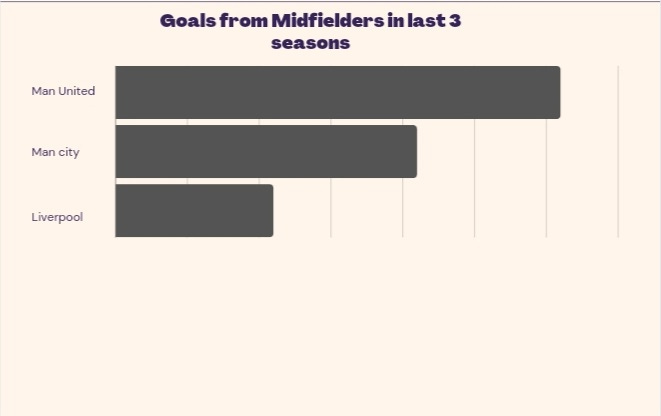
For instance, Man United’s midfield has been a consistent scoring force over the past three seasons, with 31% of their goals coming from this area. Yes, it can suggest a deliberate strategy for midfielders to push higher to support the attack, or maybe a reliance on dynamic box-to-box marauders with an eye for goal. But it really is just Bruno Fernandes doing more than the ordinary. And this season, it’s been Scott McTominay taking up advanced positions in the final third.
But we can also use Manchester City as evidence of the fluidity of the position. Their midfield goal contributions in the last three seasons have been up and down, with 21% overall, which has likely mirrored tactical shifts. Kevin De Bruyne’s 15-goal hallmark in the 2021/22 season saw Pep Guardiola focus most of his offensive actions on a midfield spearheading the attack, while Erling Haaland’s arrival shifted their offensive strategy on feeding the prolific striker.
Liverpool went the opposite direction . Their midfield averaged a mere 11.21% of goals over the last three seasons. But this isn’t a weakness; it’s a tactical choice. Mohamed Salah’s consistent goal-scoring prowess allows the midfield to focus on defensive solidity and offer creative support, freeing them from the primary scoring burden. And when you have Salah in your team, it really is the only option.
So what does this tell us?
Does a high percentage of midfield goals reveal a team’s attacking philosophy?
Absolutely.
It gives us a glimpse into whether a team thrives on a balanced attack, powerful midfield runners, reliance on a star striker, or something completely different. Midfield goals reveal a team’s strengths and how they dynamically utilize their assets, but of corse it’s not a foolproof indicator for success.
Manchester United’s current struggles highlight this. Key players underperforming, coupled with a lack of a well-defined tactical structure, lead to a disjointed system that undermines individual brilliance.
While midfield roles are dynamic, they aren’t just creators or destroyers; they can also be primary scoring threats. Their goal-scoring impact shifts with tactical strategies and individual player strengths. This is why a dominant goal-scoring forward like Haaland doesn’t negate the need for midfielders to also get in on the score sheet. What it allows for is tactical flexibility and reduces total and complete dependence on one player.
Man United do not have the consistency enjoyed by top-tier teams – a consistency that comes from a well-defined structure that encourages reliable individual performances. And with key players experiencing downturns in form, it usually mirrors the team’s overall collective performance. So, the quality of one player’s performance is merely an extension of the entire team’s performance.
Erik ten Hag’s vision for the ideal Man United system remains shrouded in mystery. He talks about wanting control but uses a swift hyper-transition-based approach, two seemingly contradictory concepts. But then he also prefers a double pivot midfield, which should realistically act as cover when most of the team is in the final third, but very often, United looks to have major gaps in that area of the pitch.
The match against Luton Town marked the first time ten Hag deployed a consistent starting line-up for two consecutive games, with Kobbie Mainoo and Casemiro anchoring the midfield. This suggests that the Dutchman has a preferred starting line-up and an ideal team structure. What is still unclear is how this all works within the structure in the tactical framework.
But in those games, both players have very different roles. Casemiro was positioned deeper than he has been at any point this season, potentially deployed as ten Hag’s solution to United’s vulnerability in transitions. But against Luton, this mild tactical shift —that lasted all for 20 minutes, saw him commit more fouls and struggle in ground duels while earning his seventh yellow card of the season.
II. High or Low
It’s a bit poetic seeing as the team’s recent tactical approach has been a study in contradictions. They’ve been trying to simultaneously execute a high press and a deep defensive block at the same time, which has created a disjointed and ultimately ineffective system.
A high press demands aggression. Forwards surge towards the opposition, forcing turnovers or maybe rushed passes. To maintain pressure and deny easy outlets, the midfield must follow suit, stepping up the pitch. But the risk here is leaving significant gaps behind them. Typically, this is where a high defensive line comes in —to compress the space the opposition has to play in, making it as small as possible.
But United’s backline stays deep instead.
This contradictory movement creates a disastrous scenario when United inevitably loses the ball somewhere in the final third. The opposition suddenly finds a vast swathe of open space in the center of the pitch. United’s defenders are too deep to react quickly, and the disengaged midfield can’t close down opponents fast enough because no one is faster than the ball.
This vulnerability is painfully obvious in the 116 shots they’ve conceded in the last 6 games – almost irrefutable proof that United’s backline works harder than any other backline in the top 6. And is that sustainable? No, it’s not.
“Twenty seconds into the game against Fulham, it’s been the problem for Manchester United all season, there’s space between the back four and the midfield,” Jamie Carragher noted.
The question becomes how the other key midfielders fit into this evolving system that doesn’t necessarily understand what it wants to be. This is where you’d ask if the focus on Casemiro’s potential defensive role in transitions would compromise the creative and attacking contributions of players like Eriksen and Fernandes. Or If control is central to ten Hag’s approach, how does that square with a transition-focused midfield structure?
We have no answers to these questions because the structure hasn’t tasked midfielders with guarding against transitions.
Think of it as connecting dots to disarm a bomb. You need to link the right dots because if you miss one, you could trigger the entire system, dooming us all into, let’s say, a nuclear apocalypse. This is how it works in football. A team lacking tactical cohesion invites chaos. Each mistimed run, each neglected defensive duty becomes a potential trigger point for the opposition to exploit.
III. The Actual Midfield
Even though Bruno Fernandes might be one of the players whose role is shrouded in mystery these days, he still retains his influence as the team’s creative linchpin. But the roles of Christian Eriksen, Mason Mount, Sofyan Amrabat, and Scott McTominay remain frustratingly ambiguous. McTominay’s recent deployment as a second-half impact substitute has proven surprisingly fruitful, with half of his seven goals this season coming from this “attacking role.”
Eriksen, despite starting 7 consecutive matches, now finds himself on the bench for the last 6 games. But even so, any potential partnership with the combative Amrabat has not been explored yet, and probably never will, which has raised questions about whether ten Hag sees them as incompatible in his system.
Mount, the club’s most expensive signing this season, has faded into obscurity. His injuries haven’t helped, but he wasn’t getting much game time before he went out injured anyway. His last appearance – a 40-minute substitute cameo against Luton in November 2023 – has raised concerns about both the future with the club and ten Hag’s actual preferred system.
To put it plainly, United has an overabundance of midfielders, each with distinct strengths, but it’s also led to a lack of cohesion within Ten Hag’s side. They appear disjointed in transitions, leaving them woefully exposed to counterattacks – a weakness that has been ruthlessly exploited by the opposition almost every single time they’ve had that chance.
Casemiro and Mainoo seem to be ten Hag’s preferred central duo, but there are still doubts because the system hasn’t been able to bring out the best out of them playing together even though on paper, their attributes almost neatly compliment one another.
But will their combination address the defensive issues exposed in the heart of United’s midfield?
The team’s current midfield predicament isn’t just about individual talents; it’s about the mismatch between those talents and a system that still struggles to find its identity. Ten Hag’s preferred central duo has potential, but their impact within the broader tactical framework remains to be seen.
 Platonotes